Cambridge Dictionary has been called out on social media after it changed the definitions of “man” and “woman” genders.
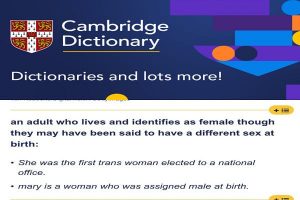
The new definition was adjusted to include people who identify as a gender other than their biological s3x.
The definition of woman, which previously was about the s3x a person was born as, according to the Cambridge Dictionary, now states that a woman is “an adult who lives and identifies as female though they may have been said to have a different s3x at birth.”
A man is now defined as “an adult who lives and identifies as male though they may have been said to have a different s3x at birth.”
However, these changes sparked wide criticisms on social media as many argued that redefining society’s categorization of gender and s3x is harmful and inaccurate.
Christopher Rufo, a fellow at the Manhattan Institute, tweeted. “Cambridge Dictionary just dropped a new definition of ‘woman’.”
Rufo also pointed out that the dictionary used the pronoun “they” to describe the subject rather than “she”.
“Notice that the dictionary writers say ‘*they* may have been.’ They couldn’t bring themselves to write ‘she may have been,’ because they know they’re lying. That’s the tell,” he tweeted.
Adam Brooks, a British social commentator, questioned whether women are happy with the change.
He wrote: “Oh wow, the @CambridgeWords dictionary definition of a woman is shocking, how did we get here? Surely women aren’t happy with this?”
Dan McLaughin, a senior writer at National Review, argued the change is Orwellian.
“1984 wasn’t supposed to be a how-to manual,” he tweeted.